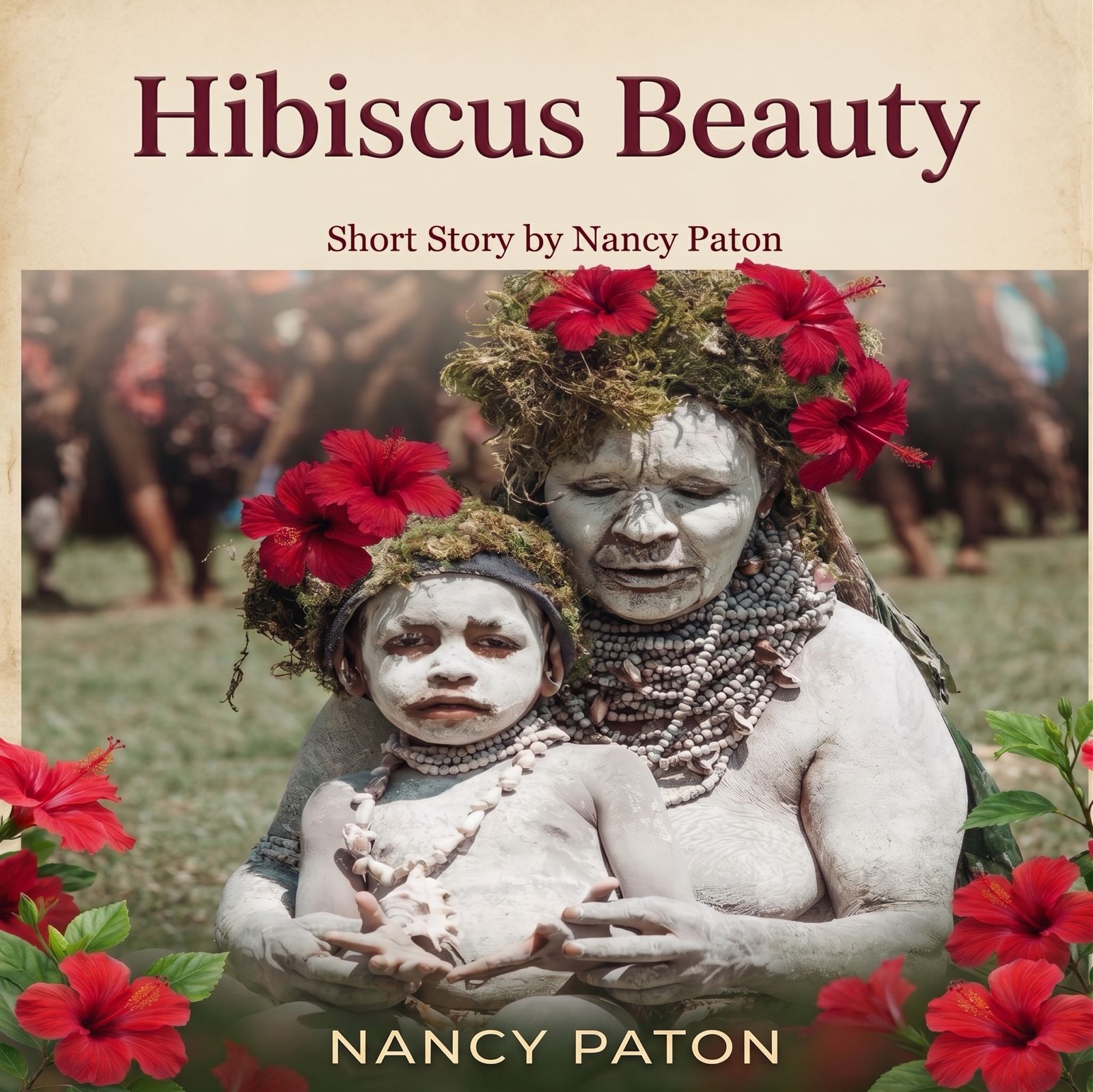
The wind had a cruel and specific voice. Buassi, Buassi, it cried, slipping through the gaps in the swollen timber. It was a trick of the highlands, a phantom that rustled the rotting banana leaves hanging from the roof. But when Kinga looked out into the rain-thick morning, Buassi was nowhere to be found.
The Waiting was a physical thing now. A heavy, humid beast that sat with her in the smoke-cured hut, its weight pressing against her chest for three weeks. But this morning, a pale, windless light ushered the new day indoors, carrying with it a fragile, fluttering ounce of Hope. Kinga smiled, a quiet, secretive thing. She reached beside her and tucked a newly blossomed, scarlet-red hibiscus flower behind her petite left earlobe. It framed her bronze, highland-carved features. To the village, she was the Hibiscus. She was the Beauty. But to be a Hibiscus in a time of The Great Drowning, and to be a Beauty in a time of War—these were dangerous things.
Kinga threw wet dirt onto the fire. The flames hissed, choking the smoke that kept the mosquitoes and the slithering things at bay. She knew precisely how to starve a fire without killing it; a highland woman’s survival was measured in the memory of embers. Gray ash coated the walls, thick as grief. On her back, her baby slept tightly bound in a bilum, the hand-woven string bag that smelled of earth, sour milk, and sweat.
“Bilum means womb, from which all life springs,” her mother’s voice echoed from a thousand yesterdays.
Young Kinga had despised the weaving. Her fingers would ache, the twine slipping, the patterns knotting into ugly, chaotic tangles. There is no art in this, Mama, she had cried, her head turned toward the outside world, toward the wet, dark earth. But her grandmother, her eyes milky with ancient knowing, would only shake her head. When the time is right, you will have your garden. It will be your life, day and night. But for now, little bird, you weave. They knew she was wild. Like the caucus, the long-tailed marsupials that watched from the canopy, Kinga possessed small ears and dark, ferociously observant eyes. Had she been given a choice, she would have lived entirely in the nocturnal embrace of the trees, basking under the naked light of a full moon. But she was a woman. At sixteen, her childhood was traded for marriage and motherhood. A guaranteed death sentence to her wildness.
Except for the dirt. The gardens were the one gift granted to the married women of the tribe.
Kinga pushed past the threshold of the hut. For the first time in twenty-one days, the sky was stripped of its bruised, weeping clouds, revealing a vaulted ceiling of crystalline blue. She glided into her garden. Her two-year-old son darted between the yams, the taro, the broad, waxy leaves of banana plants, and the creeping kau kau. She moved rhythmically, hands sinking into the volcanic soil.
But the soil was wrong. It did not crumble; it sucked at her skin like a dying mouth. As far as the eye could see, the steeply sloping mountainside was terrorized by greenery. Cultivation on the edge of the abyss. The gardens were masterpieces of desperation and genius—arrayed in checkerboard drainage ditches and circular mounds built on hot, rotting compost. Kinga’s garden was the pride of the Big Chief’s bloodline. It was bordered entirely by a bleeding edge of deep-red hibiscus shrubs. It was a radiant, luminous beacon on the faraway hill. Tribes from valleys she had never seen whispered of the glowing red garden, and of the Hibiscus Beauty who tended it.
But agricultural wealth was a liability now. The mountains were dissolving.
“Our ancestors knew the slope would protect us,” her father, the Big Chief, had told her years ago. “One way up. We see everything that comes.”
He was right about the slope, but the ancestors had not dreamed of the things that would come. The West had a sterile, clinical name for it—Climate Change. They spoke of invisible gases and warming oceans. But Kinga’s people had no schools, no textbooks, no words for carbon or emissions. To them, it was simply The Sky Rejecting Them. The khakua—the demons—had awakened, and they were furious.
For thousands of years, sacrifices had appeased the spirits of the deep-green forests of oak, beech, and red cedar. But the old magic was failing. The seasons, once governed by the rhythmic, predictable breath of the rain, had mutated into a violent, unceasing deluge. In the last three weeks, the rains had come not as water, but as an erasure. Looking down into the valley, Kinga saw the terrifying truth. The lower gardens were gone. Not just flooded, but entirely sheared from the face of the earth. Mudslides had swallowed whole communities in the night, leaving only jagged, bleeding scars of red earth where generations had lived since The Beginning of Time.
The extinction of her people was no longer a myth told around the fire; it was climbing the mountain, one collapsed terrace at a time.
And as the earth betrayed them from below, The Border closed in from the edges. The Indonesian line was a geopolitical abstraction to the West, but to the tribes, it was a creeping, metallic beast. The civil war had bled over the mountains, carried by gangs of boys with mud smeared on their faces and leafy branches twisted into their hats. They held cold, hollow tubes of Western metal that spat fire. They possessed military weapons they did not understand, and they used them with the terrifying, hollow cruelty of children playing god. They burned villages. They chopped traditional law, and human bodies, into unrecognizable pieces with rust-stained bush knives.
The horror of The Border was compounded by the terror from within. Demons and evil spirits are real all over this land. Her tribe believes in witchcraft and sorcery, and if they find a person has been taken over by a khakua, or demon, it is necessary to kill and or eat them. That is what they say happened to her sister. The accusation had shattered Kinga's world. But she knows that there was no way she had been enslaved by a demon. She knows she wasn't a witch, and it was all her sister's husband's crazy mind.
It was a madness born of fear, a tribe turning on its own as the world collapsed around them. That was why Buassi had left weeks ago, marching into the dense, evil terrain of the lower jungles. She prays that her husband proves it. But even if he survives the bush knives, the floods, and the gangs, she knows the bitter truth: But how will he even is her does it won't bring her back.
A crunch of dirt broke her reverie. Her mother stood at the edge of the hibiscus boundary.
"Any news?" Kinga asked, the words hollow, scraped out of her throat. Her mother shook her head. "I came to take the little ones to the square. The day is finally good."
Kinga surrendered the baby from the bilum. She held her son’s tiny hand for a fraction of a second longer than necessary, memorizing the fragile, bird-like bones of his fingers. The fierce, primal roar of a mother’s love deafened her to the sounds of the jungle. She had to keep them alive. Her children were soft flesh in a world of jagged teeth. Left alone, the silence of the mountain pressed against her ears.
She thought of Buassi. Not the warrior who had left to fight a ghost, but the boy who had danced for her. The highland air was cold, but on their mating day, she had worn only a skirt woven from the fiery plumage of the Kumul—the Raggiana bird of paradise. The men, too, had adorned themselves in the feathers of the gods, stamping the earth, shaking their heads violently to the hypnotic, hollow heartbeat of the wooden Kundu drums.
When Buassi saw her, he had tripped over his own feet. The other men faded.
“What do you offer the Big Chief’s daughter?” she had asked, trying to keep her sixteen-year-old face stern before biting her lip to hide a smile.
“I can provide a home. A garden. And flowers.” He had pulled a scrawny, singular hibiscus from his headdress and pressed it into her palm. He leaned in, smelling of sweat and earth. “And I promise not to take another wife.”
He had given her the flowers. Now, she only wanted him back so they could make The Choice.
It was a decision that tore at the fabric of her soul. To stay meant to cling to The Beginning of Time. This mountain held the bones of their ancestors, the umbilical cords of their children buried beneath the taro roots. To leave the mountain was to sever the bloodline, to amputate their history.
But if they stayed, the mountain would wash them away, or the men with mud on their faces would cut them to pieces. Extinction was imminent.
The alternative was The City. A place two days away on foot, across cursed terrain. A place of concrete, where spirits did not live, where the earth was paved over and dead. In The City, she would not be the Hibiscus Beauty, the daughter of the Big Chief. She would be a beggar. A ghost haunting the edges of a world that did not want her. But in The City, her children might breathe.
She could not make this choice alone. She needed Buassi to shoulder the weight of abandoning their gods.
A murmur drifted down from the village plateau. It was a jagged, frantic sound. Kinga left her tools in the dirt. She hurried her piglets inside the charcoal-blackened timber of her hut—a scar from the last village raid. As she climbed toward the square, the murmur became a wail.
Near the great communal fire ring, her father stood surrounded by the elders. The air was electric with a new, terrifying frequency.
"What happened?" Kinga grabbed the arm of an older woman.
The woman’s eyes were wide, unseeing. "The village near the border. Destroyed. The gangs came. The Indonesians gave them grenades. The Fire That Is Not Fire." Kinga’s chest tightened. Her sister’s village.
"The men are dead," another woman wept. "They took the women to the border."
The Big Chief raised his hands, his voice booming over the panic, trying to hold the crumbling sky in place. He ushered the elders into the meeting hut, leaving the women outside to drown in the shallow puddles of their grief.
Kinga’s mother found her in the crowd. They clung to each other, two anchors in a
violent sea.
"My sister?" Kinga breathed.
"Taken to the border. She lives."
"And Buassi?"
Her mother's silence was a physical blow. Nobody knew. The men who had gone to the valley were swallowed by the jungle and the war.
Later, when the shadows grew long and purple across the mountainside, Kinga returned to her blackened hut. She fed her children the last of the vegetable soup, rationing the root vegetables that were beginning to turn soft and sweet with rot. She nursed the baby. She watched their small chests rise and fall in the feathered bedding, innocent of the blood and mud soaking the valleys below.
She walked to the door. Hanging from the timber was The Metal Lock. Buassi had brought it from the western town months ago. A heavy, silver thing, cold and alien in a world of wood and twine. To keep you safe, he had said. A lock that could keep out nothing if the men with mud on their faces truly wanted to come in.
She unhinged the lock, clutching it to her breast. The cold metal warmed against her skin.
She walked out into the twilight. The old sacrifices had failed. The yams and the slaughtered pigs were no longer enough to appease the khakua or stop the Western fire. So Kinga offered the only thing she had left.
She set The Metal Lock down at the ancient stone altar at the edge of the trees. A plea to the ancestors. A trade. Take their metal. Stop their fire. Give us the answer. Bring him home.
When she opened her eyes, the sun was bleeding out into the west. The boundary of her garden caught the dying light. The scarlet petals of the hibiscus glistened, bruised and beautiful in the dark. Kinga stood at the edge of the world, a mother terrified of the morning, a wife waiting for the wind to speak his name again.